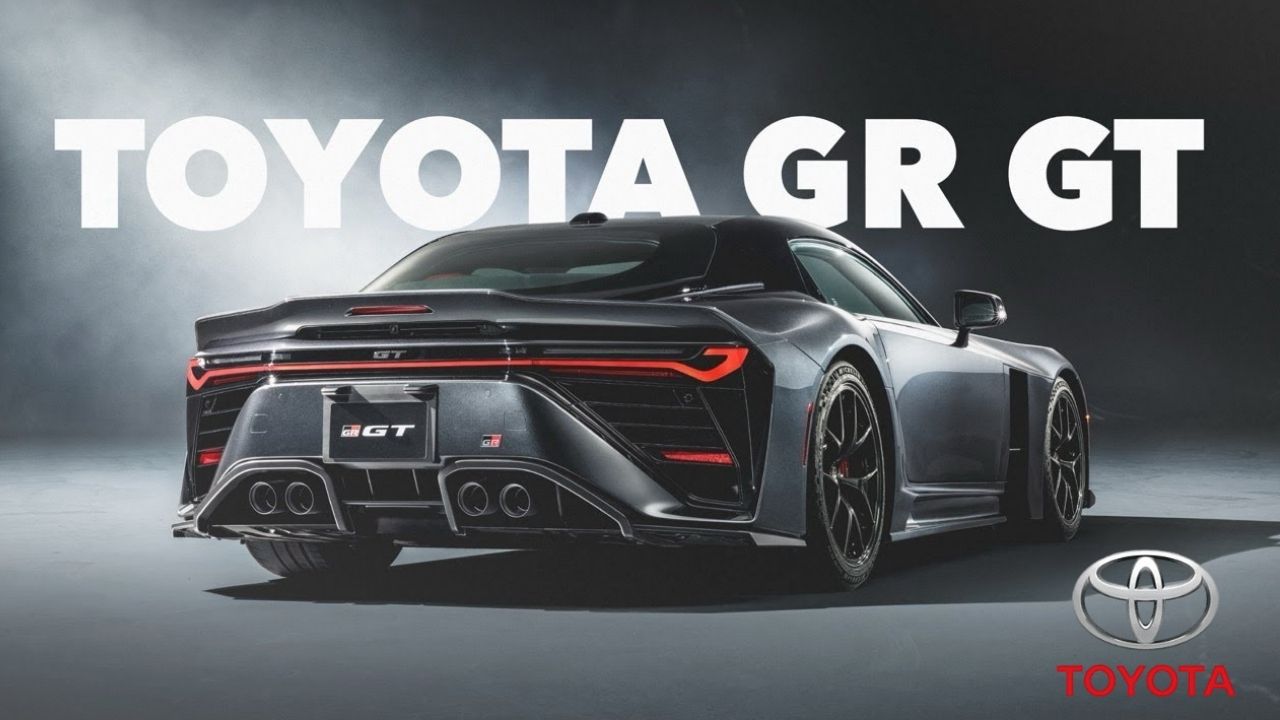
Toyota has officially stepped back into the high performance supercar arena with the reveal of the all new Toyota GR GT. Developed by Toyota Gazoo Racing as a brand new halo model, the GR GT is a road legal two seat supercar engineered with strong motorsport influence. This is not an evolution of an existing Toyota platform but a ground up project designed to showcase Gazoo Racing’s technical capabilities.
With a twin turbo hybrid V8 engine producing around 650 hp, rear wheel drive layout and a heavy focus on driver involvement, the GR GT is being positioned as a direct rival to established European icons such as the Mercedes AMG GT, Porsche 911 and Aston Martin Vantage. Toyota has confirmed that the GR GT is still under development, with market launch expected in 2027.
Toyota Brings Back Its Halo Car Spirit
One of the most significant aspects of the GR GT project is Toyota’s decision to involve engineers from the legendary Lexus LFA programme. According to Toyota, key personnel who worked on the LFA have been brought back to mentor the GR GT development team and help preserve what the company refers to as the secret sauce of its earlier halo car.
The Lexus LFA earned global respect for its engineering purity, sound and driver connection. By reusing this experience, Toyota aims to ensure that the GR GT does not become just another fast car, but one with character, balance and emotional appeal. This signals Toyota’s intent to deliver a true driver focused machine rather than a technology showcase alone.
Short Summary Table
Key Detail |
Information |
|---|---|
Model |
Toyota GR GT |
Brand Division |
Toyota Gazoo Racing |
Engine |
4.0 litre twin turbo V8 with mild hybrid |
Power Output |
Approx. 650 hp and 850 Nm |
Drivetrain |
Rear wheel drive |
Gearbox |
8 speed automatic with wet clutch |
Body Construction |
Aluminium frame with carbon fibre panels |
Suspension |
Double wishbone setup |
Expected Top Speed |
Over 320 kmph |
Launch Timeline |
Expected in 2027 |
Official Site |
Aero Focused Exterior Design
The design of the Toyota GR GT has been shaped by aerodynamics and cooling requirements first, with styling finalised only after these targets were achieved. The result is a low slung, aggressive silhouette that clearly communicates its performance intent.
The GR GT features a classic front engine supercar layout with a long bonnet, cab rear proportions and a very low roofline. It measures approximately 4820 mm in length and just 1195 mm in height, giving it a planted and athletic stance. Large vents and sculpted surfaces channel air over the brakes and through the engine bay, with airflow exiting near the base of the windscreen and towards the rear.
Toyota has used its first all aluminium body frame for the GR GT. This structure is reinforced with carbon fibre panels on key areas such as the bonnet, roof, doors and boot lid. Brembo carbon ceramic brake discs are also part of the package, highlighting the GR GT’s track focused intent.
The engine is mounted low and pushed back towards the cabin, improving weight distribution and helping achieve a targeted front to rear balance of 45:55. Toyota is aiming to keep kerb weight under 1750 kg, which would make the GR GT competitive with its European rivals despite the added mass of a hybrid system.
Stability And Chassis Engineering
Toyota has drawn heavily from its motorsport experience, particularly from its Le Mans racing programme, when developing the GR GT chassis and stability systems. The vehicle uses advanced stability control software adapted from endurance racing, designed to offer confidence at the limit while still allowing skilled drivers to explore the car’s dynamic potential.
The suspension setup consists of double wishbones at both ends, a configuration commonly used in high performance and race oriented cars due to its superior wheel control and handling precision. Combined with a low centre of gravity and wide track, this setup is intended to deliver sharp turn in and predictable behaviour during high speed cornering.
Minimalist And Driver Focused Interior
Inside, the Toyota GR GT follows the same function first philosophy as its exterior. The cabin is a tight two seat layout designed to put the driver at the centre of the experience. Visibility has been prioritised, with a low dash and slim pillars helping the driver position the car accurately on both road and track.
The dashboard design is deliberately simple, featuring physical buttons on the centre console rather than excessive touch based controls. This allows drivers to make adjustments quickly without taking their eyes off the road.
The seats appear to be carbon framed bucket units, shaped to provide strong lateral support during aggressive driving while still being suitable for everyday use. The steering wheel integrates controls for various drive modes and stability system settings, allowing drivers to tailor the car’s behaviour based on conditions and skill level.
A digital display behind the steering wheel presents essential driving information in a clear and uncluttered manner. While modern technology such as a central touchscreen and large gearshift paddles is present, unnecessary luxury elements have been avoided to keep weight down and focus sharp.
Interestingly, there is no Toyota badge inside the cabin. This reinforces Gazoo Racing’s identity as a standalone performance brand and separates the GR GT from mainstream Toyota models.
Hybrid Twin Turbo V8 Powertrain
At the heart of the Toyota GR GT is a newly developed 4.0 litre twin turbo V8 engine paired with a mild hybrid system. Toyota is targeting an output of approximately 650 hp and 850 Nm of torque. The system uses an electric motor to assist the combustion engine, particularly during acceleration and gear changes.
Power is sent exclusively to the rear wheels through an 8 speed automatic gearbox that uses a wet clutch instead of a conventional torque converter. This choice improves shift speed and driver engagement. A mechanical limited slip differential ensures effective power delivery and traction when exiting corners.
Toyota expects the GR GT to exceed a top speed of 320 kmph, although final performance figures will be confirmed closer to launch. The exhaust system has been carefully tuned to ensure the V8 delivers a distinctive and emotional sound, something Toyota recognises as crucial for a flagship performance car.
Lightweight Construction And Future Ready Engineering
Despite using a hybrid system, Toyota has focused heavily on weight reduction through extensive use of aluminium and carbon fibre reinforced materials. This approach not only improves performance but also enhances efficiency and handling balance.
Toyota has also designed the V8 engine to comply with upcoming global emissions regulations. This future proofing ensures that the GR GT can remain in production for several years without requiring major powertrain changes. It also demonstrates Toyota’s strategy of combining electrification with traditional performance engines rather than abandoning them entirely.
Positioning Against European Rivals
When the GR GT arrives in 2027, it will enter one of the most competitive segments in the performance car market. Its primary rivals include the Mercedes AMG GT, Porsche 911 and Aston Martin Vantage. Each of these models has a strong heritage and loyal customer base.
Toyota’s advantage lies in its motorsport experience, reputation for engineering reliability and the emotional connection it hopes to recreate by involving LFA era engineers. By offering a hybrid V8 setup, lightweight construction and a strong focus on driver involvement, the GR GT aims to stand out rather than simply match its competitors.
Frequently Asked Questions
Q1. What is the Toyota GR GT
The Toyota GR GT is a new flagship supercar developed by Toyota Gazoo Racing. It is a two seat, road legal performance car designed from scratch with strong motorsport influence and intended to rival models like the Mercedes AMG GT and Porsche 911.
Q2. What engine does the Toyota GR GT use
The GR GT uses a newly developed 4.0 litre twin turbo V8 engine paired with a mild hybrid system. The target output is around 650 hp and 850 Nm of torque, with power sent to the rear wheels.
Q3. When will the Toyota GR GT be launched
Toyota has confirmed that the GR GT is still under development, with sales expected to begin in 2027. An exact launch date will be announced closer to production readiness.
Q4. How fast will the Toyota GR GT be
While final figures are not yet confirmed, Toyota expects the GR GT to achieve a top speed above 320 kmph, placing it firmly in the high performance supercar category.
Q5. How is the GR GT different from previous Toyota sports cars
Unlike models such as the GR Supra, the GR GT is a ground up flagship project developed specifically by Toyota Gazoo Racing. It uses a hybrid V8 engine, extensive lightweight materials and involvement from LFA era engineers, making it Toyota’s most ambitious performance car in decades.
Conclusion
The Toyota GR GT represents a bold step for Toyota Gazoo Racing and marks the brand’s serious return to the top tier of performance cars. With its 650 hp hybrid twin turbo V8, lightweight aluminium and carbon fibre construction, and driver focused philosophy, the GR GT is shaping up to be a true flagship.
Scheduled for a 2027 launch, the GR GT is not just about speed or specifications. It is about recapturing the emotion and purity that defined Toyota’s last halo car while embracing modern technology and electrification. If executed as promised, the GR GT could become one of the most compelling alternatives to established European supercars.
For More Information Click HERE